
Funded Master's Opportunity: Exploring the role of family members during adult braille learning: Co-creating resources for success
Note: Although this is primarily an opportunity for a Masters student, students interested in pursuing Ph.D. studies on this topic are also welcome to submit an expression of interest.
Are you interested in research that advances literacy equity and information access for people who are blind or low vision?
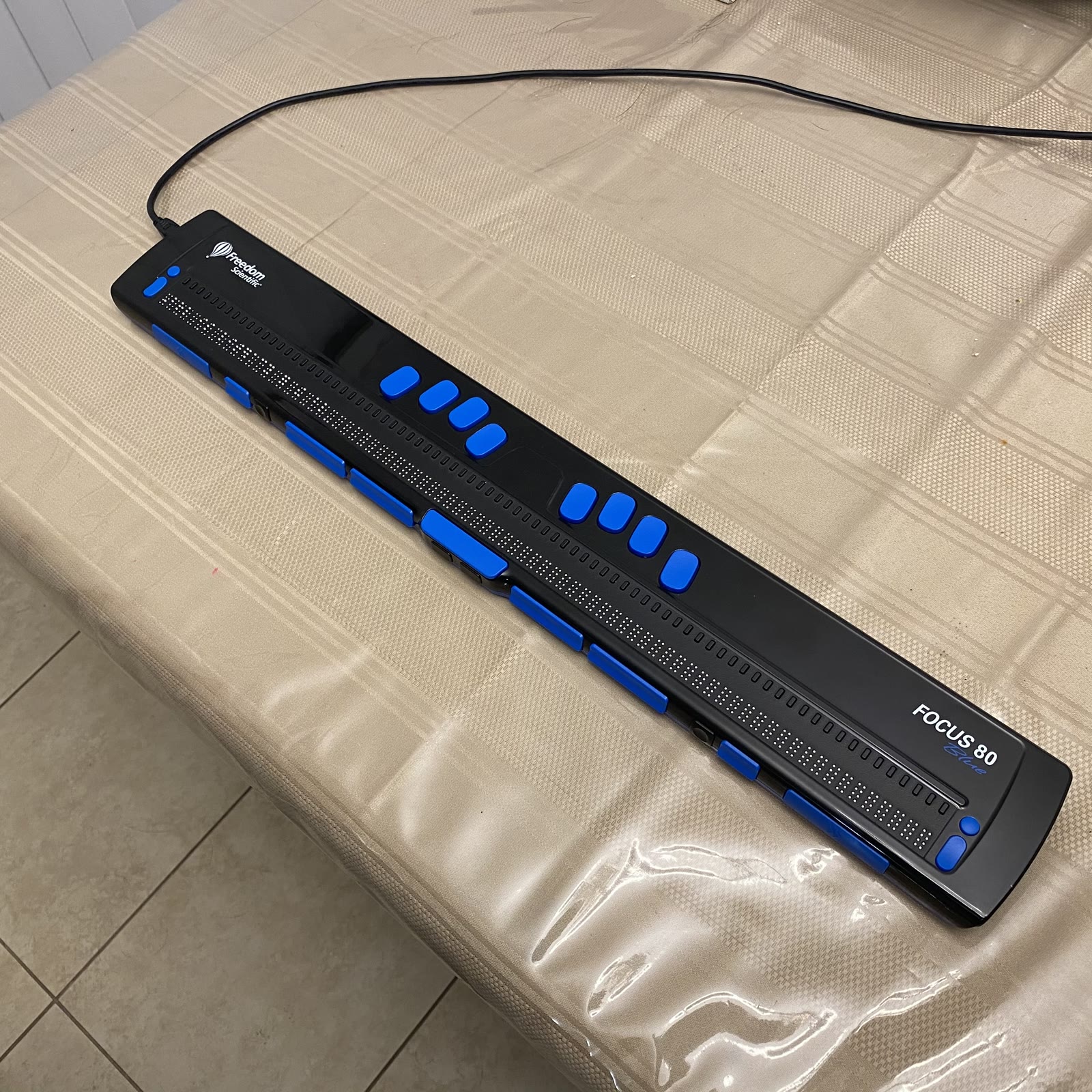
Braille is a tactile reading and writing system used by millions of people who are blind, DeafBlind or have low vision worldwide. Equal to print as a form of literacy, braille provides access to information in education, employment and daily life. The United Nations Sustainable Development Goals emphasize equitable access to literacy and education, including for people with disabilities, while the UN Convention on the Rights of Persons with Disabilities recognizes braille as essential to accessibility, communication, education and participation. Globally, people who can read and write have greater social opportunities and upward mobility, and people who are blind are no exception. Research shows that braille literacy is associated with higher levels of education, employment and income among adults who are blind. This is especially important given the persistently high unemployment and underemployment rates among people who are blind or have low vision worldwide. Questions surrounding braille therefore extend beyond education and rehabilitation: they are also questions of equity, autonomy and inclusive participation.
As the population ages, a growing number of adults who become blind or develop low vision later in life may benefit from learning braille. Although we know that parents and families play an important role in supporting children who learn braille, far less is known about the role, the experiences and the needs of families and friends who might support adult learners. This funded master’s opportunity places you at the centre of that question.
Applications are invited from students interested in pursuing a research-based master’s degree in Vision Science (blindness and low vision rehabilitation option) under the supervision of Dr. Natalina Martiniello at the School of Optometry, Université de Montréal. The successful candidate will undertake participatory research, in close collaboration with the blind and low vision community, to explore the role of families in adult braille learning and to co-develop practical resources that help families provide effective support.
The Project
The successful candidate will have the opportunity to explore:
The role that family members play during adult braille instruction;
The facilitators and barriers experienced by families during adult braille learning, from the perspective of adult learners and their families; and
The information, strategies and resources that families would benefit from to better support adult braille learning and usage.
The project will draw on literature reviews, in-depth interviews with adult braille learners and family members, and a co-design workshop bringing together learners, families and other stakeholders to develop a practical resource for families. Findings aim to provide concrete tools and insights for families, adult braille learners, rehabilitation professionals and educators.
The Supervisor and the Lab
Dr. Martiniello is an Assistant Professor in blindness and low vision rehabilitation, a lifelong braille reader and a Certified Vision Rehabilitation Therapist. Her research focuses on advancing braille learning and literacy throughout adulthood, non-visual accessibility, and inclusive participation for people who are blind or have low vision.
The Martiniello Braille Research Lab conducts applied, stakeholder-engaged research that positions braille literacy and non-visual accessibility as fundamental to equitable access to information and participation for people who are blind. The lab is unique in Canada, and among the few worldwide, for its dedicated focus on advancing braille learning and literacy beyond childhood.
Students join a research environment where both lived and learned experience is recognized as expertise. Learn more about the lab at https://mbrl.ca.
The Environment
The School of Optometry at Université de Montréal offers an interdisciplinary research environment in vision science that is distinctive. The department includes faculty members who study vision from across the spectrum, from fundamental visual science and optometry, to blindness and low vision rehabilitation, accessibility and social participation. It is home to the only Graduate program in Visual Impairment and Rehabilitation in Canada, available in both English and French.
The university is located in Montreal, a world-renowned bilingual city celebrated for its vibrant culture, festivals, food and quality of life, and consistently ranked among the best student cities in the world.
Who Should Apply
This opportunity would suit a student with an academic background in vision rehabilitation, teaching students with visual impairments, adult education, special education, accessibility, social work, psychology or a related field. Since this is a research-based master’s degree, this opportunity is particularly geared towards students interested in pursuing a research career in the field of blindness and low vision.
Eligible applicants should hold an undergraduate degree in a related field (or have completed undergraduate studies prior to the start date of the master’s in September 2027). Familiarity with braille, whether as a braille reader, family member or professional, is required. Students without adequate knowledge of braille will complete an approved braille course as part of their master’s studies. Prior experience conducting qualitative research commensurate with the undergraduate level (e.g., an undergraduate thesis or research project) is a strong asset. Strong English communication skills (written and oral) are required.
The successful candidate will be located in Montreal, Quebec, for the duration of the two-year master’s degree. Funding is available, with support to pursue additional fellowships and grants upon successful selection.
How to Apply
Interested applicants should submit the following to natalina.martiniello@umontreal.ca by November 15, 2026:
A curriculum vitae
The name, position and email address of two academic references
A brief statement of research interests, including how this opportunity aligns with your research goals and interests (one page)
All applicants will receive an email to confirm that their application has been received. Successful applicants will be invited for a Zoom interview. Zoom interviews will take place in October and November 2026, until a candidate has been selected. Have any questions? Write to natalina.martiniello@umontreal.ca to learn more. Thank you in advance for your interest and please feel free to share widely!