
Accessibility and Access Technologies
Exploring the selection, use and impact of technologies that provide non-visual access to information in education, employment and every day life.
Access to communication in the widest sense is access to knowledge.
— Louis Braille
Overview
What is assistive / access technology?
Assistive technologies improve access to information and to environments for people who are blind or low vision and for other users who experience print reading disabilities. Technologies that provide non-visual access include:
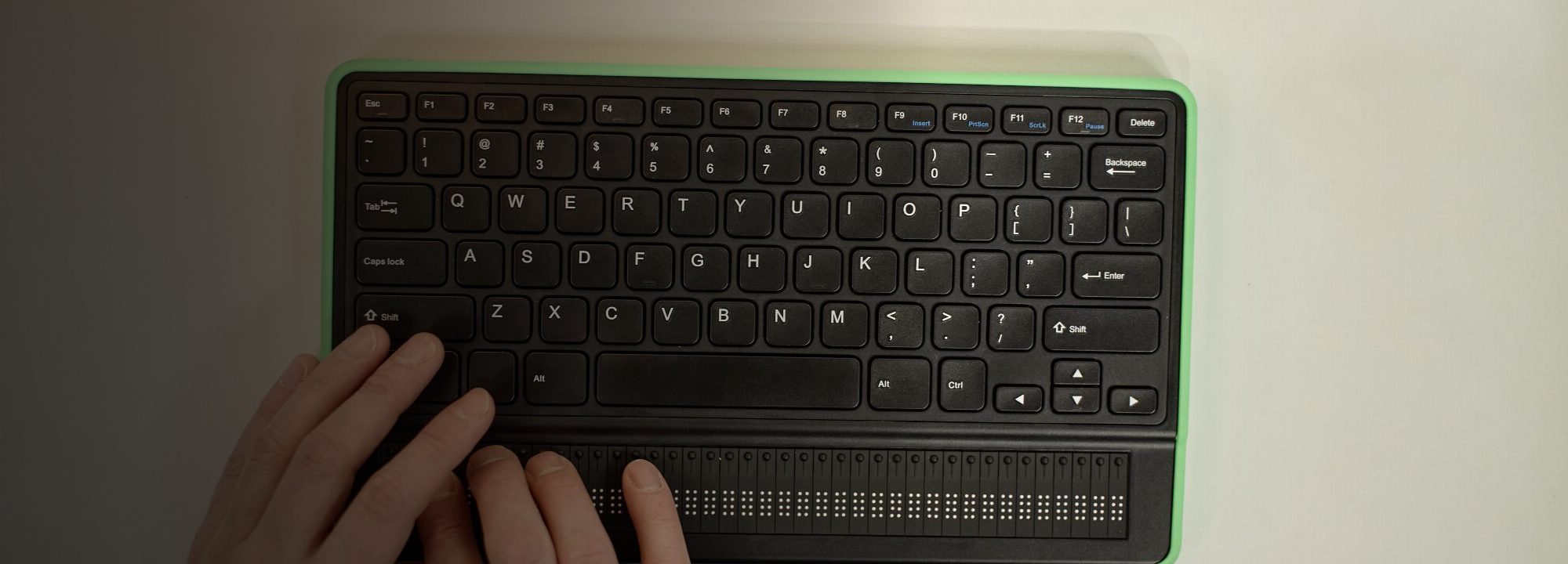
Refreshable braille displays and braille notetakers that convert printed text into braille through pins that rise and fall to form braille symbols;
Screen-reading software, which converts text and other on-screen information into speech or electronic braille;
Audiobooks and accessible digital book players and apps;
Tactile graphics and technologies used to produce or display them; and
Apps and devices that provide access to printed text, object identification or environmental information, through the use of optical character recognition (OCR) and, increasingly, artificial intelligence.
The broader term access technology is increasingly used to recognize that accessibility is no longer provided only through specialized assistive devices. It also includes mainstream technologies — such as smartphones, tablets, smart glasses and computers — with built-in accessibility features that can be used by people with and without disabilities.
Universal design is the recognition that when tools and spaces are proactively designed to be more universally accessible, they expand access for users who are blind, but also benefit everyone. For example:
Buildings with ramps and elevators improve access for people with mobility disabilities while also benefiting older adults, travelers with luggage and parents pushing strollers;
Learning environments that provide accessible electronic materials enable students who use screen readers or braille displays to participate more independently while giving all students flexible and portable access to course content;
Technologies with built-in speech and braille support provide essential access for people who are blind or have low vision, but audio is also increasingly used by sighted people who listen to information while driving or completing other activities; and,
Technologies with built-in accessibility features support the transition to non-visual access methods for users who develop low vision or blindness later in life (including those with age-related sight loss), allowing them to use the same tools they enjoyed before.
The starting point
In this lab, both the terms assistive and access technologies are used interchangeably. However, access technology is used as an inclusive term for any tool that enables access to information, activities or environments. This definition encompasses specialized assistive devices, accessibility features within mainstream products and emerging technologies. This broad perspective recognizes the importance of examining the range of available technologies that provide non-visual access to information, as well as the personal, technological, social and environmental factors that shape device selection, training and usage. It also moves beyond viewing accessibility as the sole responsibility of specialized companies, emphasizing the essential role that all technology developers play in proactively anticipating and designing for diverse user needs.
Selection
The expansion of assistive and emerging technologies, including lower cost devices, will increasingly provide greater options to users who draw on braille and other non-visual access methods. Research in the lab contributes to evidence-informed indicators that users and rehabilitation professionals can draw on to help guide technology selection. These findings also provide developers with information about the importance of including diverse users throughout the design and evaluation process, including adults and aging users. Examples of themes explored in the lab include understanding the role of:
Spatial characteristics of refreshable braille displays on braille reading performance, including the role of line-length and dimension (single vs. multi-line displays) across diverse user profiles and tasks;
Ergonomics, portability and the placement and accessibility of buttons, controls and interfaces for adult and aging braille users;
The complexity and usability of software; and
Questions around user preference, privacy, access, cost and other external factors.
Training
Research in the lab explores the effective use of assistive and emerging technologies among both rehabilitation professionals and users, including strengths and limitations of emerging tools and how technology innovations are shaping (or hold the potential to shape) blindness rehabilitation practice. Themes explored in the lab include:
The effectiveness of gamification within adult braille instruction;
Strengths and limitations of telerehabilitation (remote and hybrid instruction) for adult braille learners, including those who remain under-served due to geographic, transportation or service-access barriers;
The responsible use of artificial intelligence in blindness rehabilitation practice, including how professionals are using AI in their own work and facilitators and barriers that shape their readiness to teach AI-based tools;
The teaching and use of social media platforms and technologies among blind and low vision youth, including questions around accessibility, usability, privacy, safety and identity formation.
Use of technologies in education, employment and every day life
No single technology works equally well for every user, task or environment. A tool that is effective for reading a short message may be less suitable for navigating a complex document or accessing information in the workplace. Research therefore examines the strengths and limitations of different technologies across diverse user profiles and tasks, including how the nature of the task shapes efficiency, accuracy, portability, privacy, user preference and ease of use. The use of technologies to expand non-visual access to information is explored across:
Postsecondary education and research;
Employment;
Daily living activities; and,
Community and social participation.
Highlighted Publications
-
Bleau, Maxime, Martiniello, Natalina, Gingras-Royer, Nathalie, Tardif-Bernier, Catherine and Nemargut, Joseph Paul (2025). Exploring the use of smartphone applications during navigation-based tasks for individuals who are blind or who have low vision: future directions and priorities Disability and Rehabilitation: Assistive Technology, 21(2), 840-868. Journal Article
-
Martiniello, Natalina (2024). The shifting landscape of digital accessibility for students with visual impairments in K-12 schools: Inclusion, diversity, equity, and accessibility Cases on Effective Universal Design for Learning Implementation Across Schools, 219-252. Book Chapter
-
Fichten, Catherine, Martiniello, Natalina, Asuncion, Jennison, Coughlan, Tim and Havel, Alice (2023). Changing times: emerging technologies for students with disabilities in higher education Handbook of Higher Education and Disability, 131-148. Book Chapter
-
Martiniello, Natalina, Eisenbarth, Werner, Lehane, Christine, Johnson, Aaron and Wittich, Walter (2019). Exploring the use of smartphones and tablets among people with visual impairments: Are mainstream devices replacing the use of traditional visual aids? Assistive Technology, 34(1), 34-45. Journal Article