
Social Inclusion and Participation
Promoting inclusive participation and equitable access to information for blind and low vision individuals in education, research and beyond.
Disability doesn't make you exceptional, but questioning what you think you know about it does.
— Stella Young
Overview
Education and rehabilitation services provide people who are blind or low vision with the tools, strategies and skills needed to pursue their personal, educational and employment related goals. This is important, but also only one part of the story. People who are blind or low vision may still encounter barriers that limit their participation, due to external factors including the accessibility of digital and physical spaces, access to information in braille and other formats, limited access to positive portrayals and blind role models, and the perceptions, stereotypes and stigma that others may (often unconsciously) hold. These factors continue to shape postsecondary and employment outcomes and broader social participation.
Positive advancements
In recent years, national and international frameworks have brought greater attention to the role that societies collectively play in shaping inclusive participation and equitable access to information. These include the United Nations Convention on the Rights of Persons with Disabilities, the Marrakesh Treaty, the World Health Organization’s Global Report on Health Equity for Persons with Disabilities, and in Canada, the Accessible Canada Act and National Strategy for Eye Care Act.
Similarly, recently introduced Accessibility action plans developed by research funding agencies also reflect the importance of addressing external barriers that shape outcomes in higher education and research.
Through the power of stories, many people who are blind, deafblind or low vision are also using their platforms to educate others, address misconceptions and reshape narratives around braille, blindness and the many diverse definitions of what it “means to be blind”. For example, the experiences of people new to sight loss will be very different from those who have always been blind. First-hand perspectives redefine braille and other tools of blindness not as symbols of disability, but of empowerment and choice.
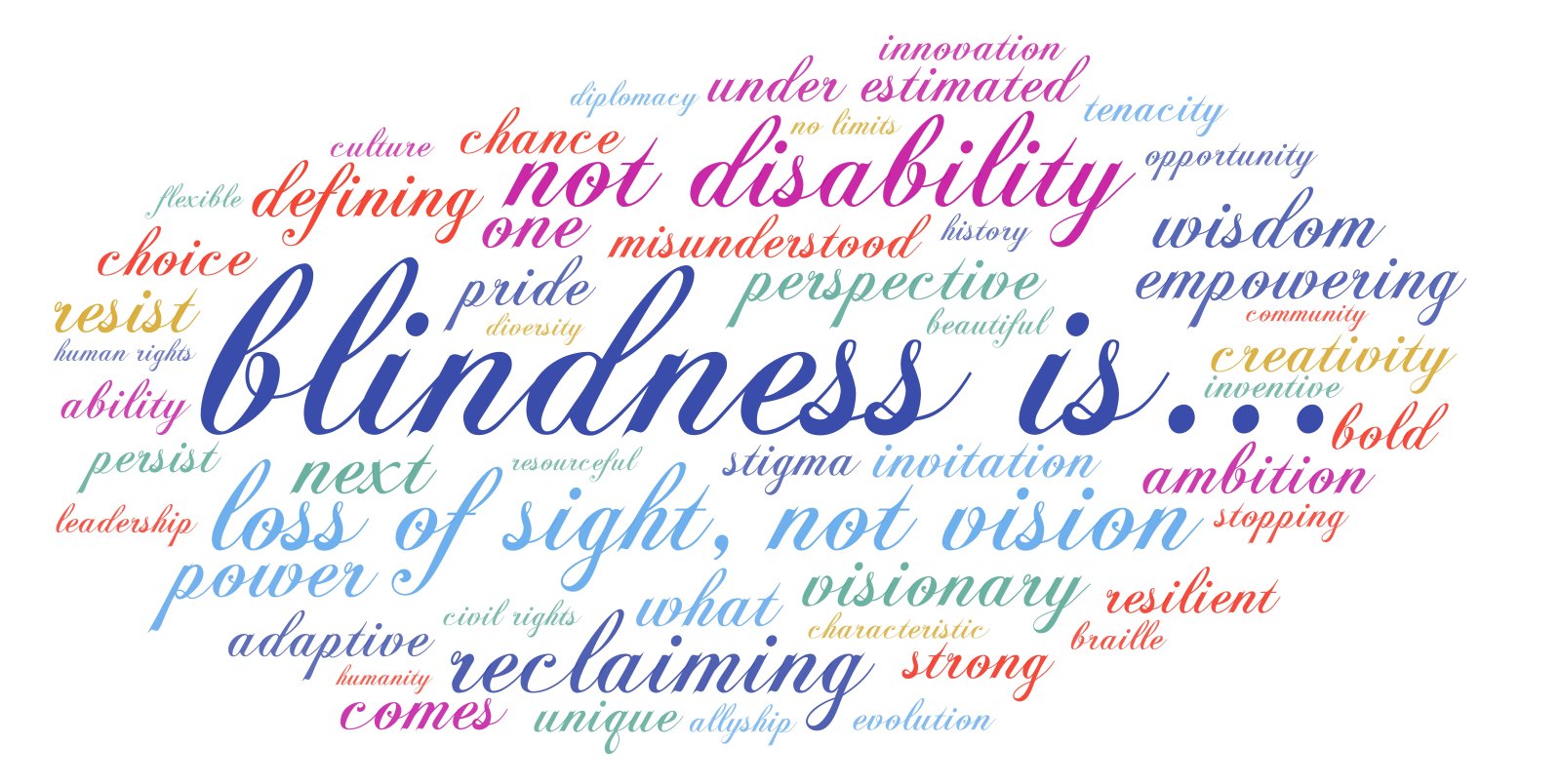
We asked blind people what words came to mind when defining ‘blindness’. This word cloud shows the most common responses.
A Participatory, Strengths-Based Approach
Research in the lab takes a biopsychosocial approach that recognizes the interaction between personal and external factors that shape inclusive participation and access to information. While the role of personal factors (for example, age of onset, individual ability and age) are important to consider, many of the disabling barriers experienced by people who are blind or low vision can be addressed through positive perceptions and actions. For example, when a blind person has access to a menu in braille, they are not disabled in that moment, although they are blind. Rooted in the social model of disability, this perspective centers the lived experiences of blind and low vision people and fosters collaboration among stakeholders with and without sight to co-design tools, resources and solutions that address the barriers raised.
With a focus on non-visual accessibility, themes explored include:
Factors that help and hinder postsecondary and employment outcomes, including access to braille and other non-visual formats, accessible technologies and universal design;
Accessibility experiences of blind scholars across the academic library journey, including tools to support the knowledge, attitudes and practices of academic librarians;
Accessibility across the research cycle, including study design, data collection, data analysis and dissemination (conferences and publications), especially for those who use braille and other non-visual access methods;
The experiences of blind, deafblind and low vision researchers who conduct qualitative research using braille and other non-visual strategies;
Accessibility in libraries, theatres, museums, and other social and cultural activities, especially as this relates to braille, accessibility and universal design.
Highlighted Publications
-
Oestreich, L., Totzek, J. F., Ratnanather, J. T., Kam, J., Borghesani, V., Mah, L., Olsen, R. K., Haroon, H. A., Martiniello, Natalina and Kangjoo, L. (2026). Accessibility in academic conferences: Barriers, solutions, and a framework for inclusive participation ↗ Aperture Neuro [Preprint]. Journal Article
-
Martiniello, Natalina and Wittich, Walter (2024). A duoethnography on disability and allyship within a Vision Science Doctoral Program: Perspectives on inclusion, diversity, equity, and accessibility International Journal of Qualitative Methods, 23. Journal Article
-
Rizzo, J. R., Rosenblum, L. Penny, Samuel, C., Wittich, Walter, Martiniello, Natalina, Johnson, Aaron, Wu, Y.-H., Sukhai, Mahadeo and Swenor, Bonnielin (2024). Accessible scientific conferences for blind and low vision professionals and researchers: A necessary step for achieving STEMM equity Disability & Society, 1-7. Journal Article
-
Martiniello, Natalina (2024). The shifting landscape of digital accessibility for students with visual impairments in K-12 schools: Inclusion, diversity, equity, and accessibility Cases on Effective Universal Design for Learning Implementation Across Schools, 219-252. Book Chapter
-
Martiniello, Natalina and Shaw, Ashley (2023). How to navigate the academic library: empowering blind scholars on their quest for knowledge ↗ Digital Accessibility in Academic Libraries Community of Practice [Webinar]. Conference Presentation
-
Wu, Yueh-Hsun, Martiniello, Natalina and Swenor, Bonnielin K (2021). Building a More Accessible Conference for Researchers With Vision Impairment JAMA Ophthalmology, 140(2), 113-114. Journal Article
-
Martiniello, Natalina and Wittich, Walter (2019). Employment and visual impairment: Issues in adulthood Routledge Handbook of Visual Impairment, 415-437. Book Chapter
-
Fichten, Catherine S, Nguyen, Mai N, Asuncion, Jennison V, Martiniello, Natalina, Jorgensen, Mary, Budd, Jillian, Amsel, Rhonda and Libman, Eva (2016). An exploratory study of college and university students with visual impairment in Canada: Grades and graduation British Journal of Visual Impairment, 34(1), 91-100. Journal Article
-
Fichten, Catherine S, Asuncion, Jennison V, Wolforth, Joan, Barile, Maria, Budd, Jillian, Martiniello, Natalina and Amsel, Rhonda (2012). Information and communication technology related needs of college and university students with disabilities. Research in Learning Technology, 20. Journal Article